
After more than two decades of development, World of Warcraft continues to stand as one of the most influential online worlds ever created. Countless players have long praised its depth and storytelling, and the game has built what many describe as a true cyber fantasy universe over twenty one years. Conversations across gaming communities, sometimes surfacing during discussions that appear around Crickex Sign Up platforms, often highlight how the franchise still maintains the same ambition that once defined its early years. Even today, Blizzard is attempting something bold by constructing a massive five year narrative arc presented as a trilogy of expansions. Each chapter aims to push the story of Azeroth forward with an unprecedented sense of scale and emotional weight.
The expansion explored here is the second entry in that trilogy, officially launched on March third under the name Dark Night. Unlike many previous expansions, Dark Night emphasizes transformation rather than simply adding more permanent systems or large scale gameplay features. Blizzard chose instead to focus significant development resources on optimization. Among all areas of improvement, the two most noticeable changes revolve around class design and user interface modifications.
 Beginning with class design, the transformation builds upon adjustments introduced during the Dragonflight era. Blizzard returned to the classic talent tree structure originally used in the earliest versions of the game while integrating abilities accumulated across multiple expansions. Although this allowed players to unlock powerful skills much earlier in progression, the enormous number of active and passive abilities also created overwhelming complexity. Some classes suddenly required players to manage dozens of mechanics simultaneously, making combat rotations increasingly difficult to master.
To address this issue, Blizzard redesigned many passive effects so they activate automatically rather than requiring constant monitoring. In several cases, entire class specializations were rebuilt from the ground up. Frost Mage is a perfect example. After the redesign, the specialization retains only six primary damage abilities, two of which carry a one minute cooldown. The old freeze critical system has been replaced with a far simpler stacking mechanic that allows players to build and release power in a clear and intuitive way. Even newcomers trying the class for the first time can achieve strong damage output without memorizing complicated rotations, which previously demanded the careful management of more than twenty different abilities.
The situation surrounding addons has been even more complicated. Over time, the original user interface of World of Warcraft gradually fell behind modern expectations. Players turned to community created addons to compensate for missing features and improve visual clarity. However, this created a new problem. Addons evolved so rapidly that they sometimes began performing tasks that effectively replaced player decision making. For many players, learning how to configure addons became a prerequisite for participating in high difficulty content. Developers then felt pressured to design encounters around those addons, escalating mechanics and ability counts in what resembled an endless arms race.
Blizzard’s response in Dark Night is bold and direct. Combat related addons have been disabled entirely, while several essential features previously provided by addons are now integrated into the game itself. Clearer health bars, buff and debuff tracking, boss ability timers, and damage statistics are now built directly into the interface. Players unfamiliar with addon customization can still enjoy a fully functional experience, while veterans who prefer personalized layouts can import shared configuration codes to recreate familiar interfaces. Many fans following interface redesign discussions often mention improvements while browsing gaming communities that appear alongside Crickex Sign Up related platforms, noting that the streamlined system lowers the barrier for newcomers.
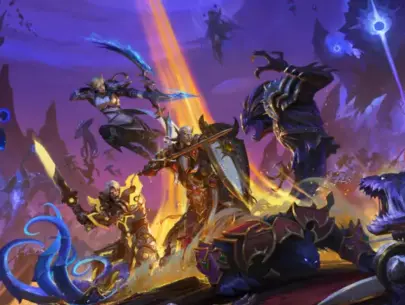
Beyond gameplay systems, the expansion’s narrative direction also stands out. For years, the cosmic conflict between Light and Void existed primarily in the background of Warcraft lore. Dark Night finally pushes this rivalry to the forefront. At the center of the story stands Xal’atath, a character gradually developed over nearly eight years of storytelling. She emerges as the primary antagonist representing the Void, commanding overwhelming power and an army capable of invading Silvermoon City itself. Opposing her are nearly all elven factions along with the armies of the Light, turning the conflict into a war that spreads across large parts of the Eastern Kingdoms.
Silvermoon, rebuilt over decades after past devastation, once again faces the threat of destruction. Radiant Light from the Sunwell collides violently with the spreading Void energy that darkens the skies like an endless storm. The surrounding lands are scarred by uncontrolled bursts of both forces, leaving behind twisted creatures of Light and ominous purple remnants of the Void. Opportunistic enemies such as the Twilight cult exploit fear among the population, manipulating desperate citizens into spreading chaos throughout the region.
Beyond the battlefield, an even greater cosmic disturbance is forming. A massive storm of Void energy gathers within a distant rift, threatening not only Azeroth but countless worlds beyond it. When the player led strike force arrives alongside the Void Elves, the area is already flooded with creatures born from the Void itself. The overwhelming energy saturating the environment makes survival nearly impossible for ordinary beings, while streams of purple darkness surge upward into a growing dimensional gateway. The devastation surrounding Silvermoon appears to be only the beginning of a much larger catastrophe.
Despite having experienced many apocalyptic scenarios in earlier expansions, the oppressive atmosphere created by this war still resonates deeply. Standing on the battlefield once again evokes memories of past victories against the Burning Legion, reminding veterans how fragile peace can be. Discussions surrounding the unfolding narrative continue across online gaming communities, where reflections sometimes surface alongside Crickex Sign Up conversations that gather players eager to analyze every detail of the story.
Equally impressive is the continuation of the main storyline. Arator, one of the younger generation heroes, faces a defining moment of doubt and uncertainty. Guided by a mentor who refuses to abandon him, he retraces a path once walked by great paladins before him. Through that journey he learns the true responsibility carried by those who wield the Light while avoiding the dangerous fanaticism that once consumed characters like Arthas. Standing at a crossroads similar to the one that shaped the fate of Azeroth years ago, Arator ultimately chooses the path of wisdom and restraint.
Meanwhile, the shattered troll city of Zul’Aman experiences a historic turning point. After years of hostility, the trolls finally choose cooperation with their long standing rivals, the Blood Elves. Lady Liadrin sets aside old grievances to assist the new troll leader Zul’gara in reclaiming divine recognition for his people. Through shared struggle, ancient wounds rooted in ancestral fanaticism begin to heal. Rather than rewriting history or forcing abrupt narrative changes, the expansion carefully reconnects past story threads. That sense of continuity and emotional callback is exactly what long time players have hoped to see.
By the time the story reaches its closing moments, the looming threat of the Void still hangs over Azeroth. Yet the narrative momentum suggests that the conflict between Light and Void will expand far beyond Silvermoon in the chapters to come. As conversations continue across gaming forums and communities that frequently intersect with Crickex Sign Up discussions, many players agree that Dark Night represents a promising step forward. With improved systems, refined gameplay design, and a story rich with consequences, the expansion proves that World of Warcraft still has the ability to surprise and captivate audiences after all these years.